Tuesday, June 30, 2020

Tunic or not tunic

My dear old Pfaff has been having a bit of a rest for the past few months. I did revise my basic knit top pattern, with both set-in and raglan sleeves, for a somewhat looser fit, and I made prototypes of each. Beyond that all I have sewn is masks...ho-hum. So I thought I would review a couple of garments I made at the end of last year and the beginning of this.

One plus of getting older is, hopefully, knowing yourself. Knowing your strengths and abilities, and your weaknesses as well. Knowing how to make the most of the former and cope with the later. At the same time, it's also important to remain open to possibilities and to change. I don't want to be that frowning old lady pounding my figurative cane and decrying everything about life today.

That's true about fashion, too. I think I know what suits me, what flatters my small but not especially slender frame. I know how I want to look, the kind of styles that make me feel mentally at ease. But, once again, I don't want to get stuck in time, closed off to what's new. So, although I don't feel the need to keep up with trends, I do venture out of my fashion comfort zone from time to time. 

Now, tunics are not exactly cutting edge, I know. Young and old, everyone is wearing tunics. Not only are they comfortable, they also glide forgivingly over buldges. My main problem is with proportion. Since a tunic falls below the hips, it visually shortens the legs, an oh-oh for already short-limbed me. Still, I was taken with the creative tunic designs from Marcy and Katherine Tilton in Vogue and Butterick patterns.

Then I fell in love with a digital print knit from Mood Fabrics. It has the deep reds and purples that go with so much in my wardrobe. But it's also a very busy print, so I knew I needed to make it into a simple garment, something flowing that would show it off. Butterick 6136, a tunic by Katherine Tilton seemed to be the answer. The photo of View C on the pattern envelope even showed it made up in an equally busy print.

First, of course, I made a trial version in some of my seemingly inexhaustible stash of old cotton interlock which I over-dyed (from a tint that looked liked the old Flesh crayon) in a rich Procion color called Pomegranate. I used the size M cutting lines, but I think it would have fit better had I used S, because it is generously sized. The pattern description says it is fitted through the bust, which I take to mean more close-fitting than my tunics turned out. I think I would have been happier with them if I had simply made them less roomy.

I adjusted for proportion by shortening it about 2 inches on the “skirt” section. I shortened the sleeves considerably which I have to do on every pattern and narrowed by shoulders by 3/4”. I also narrowed the upper back by about 1/2”.

It's a very easy garment to sew, nothing whatsoever complicated about it. For the solid color tunic, I made View B with the stand-up collar and decorative top-stitching which I did with a small machine embroidery stitch and regular thread. Then I added beads along the stitching to give it a bit more emphasis. I also added a line of decorative stitching with beads down the back.

So I wore it and liked it well enough that I thought the pattern would indeed be just right for the Mood print. Even better, in fact, because the print fabric was softer and drapier than the cotton interlock and would look a bit sleeker. Or so I thought.

This time I used View C which is exactly the same except for the twist collar and no decorative stitching. Even easier to make the second time, of course. But when I tried it on, I felt overwhelmed by the print, by such a large expanse of print. Mr. C convinced me to wear it once, and it looks better in the photos he took of me than I thought it looked when assessing it in the mirror. But I don't see it turning into a go-to garment as I had expected all the times I had looked at the beautiful fabric before sewing it up.

So, is there a moral to this sewing story? Hmmm.... Maybe learn from your mistakes. Well, not really mistakes, but not stellar successes. Unlike trying on a garment in a store, you can never be totally certain of the sewing outcome, no matter how long you have been sewing, no matter what prep you do to make the garment as perfect for you as possible. I tried something a bit different for me, and maybe I'll come to like them more with time.


Friday, May 22, 2020

Digital diversions

Glimpse of a river in Arkansas
During this period of “sheltering in place,” we are fortunate, Mr. C and I, to have a place that shelters us most pleasantly. There's plenty of space where we can each pursue our individual interests undisturbed. This tumultuous time that has upended lives around the world has so far changed our days only slightly. In fact, I am almost grateful for the additional time that staying home all day every day has given me. 
  
When I haven't been spring cleaning or attending to the exuberance of greenery out in the yard, I've been immersed in pushing pixels around on my computer screen . After many years of using Photoshop CS3 (which debuted in 2007), I finally subscribed to Adobe's Creative Cloud Photography plan which includes the latest Photoshop and Lightroom Classic. Why had I been waiting!


Of course, I wanted to catch up to all the advances in Photoshop plus learn about Lightroom which I didn't have before, so I've been on a YouTube marathon. There are many, many excellent video tutorials given by people who really know the intricacies of these programs. I am simply amazed at both the depth of their knowledge and the seemingly infinite effects that are possible.


Anthony Morganti has been guiding me through Lightroom with his very clear and detailed series of Mastering Lightroom Classic CC. And I have long subscribed to Phlearn with Aaron Nace and PiXimperfect with Unmesh Dinda. As well as learning from their digital mastery, I appreciate their obvious enthusiasm for Photoshop. An enthusiasm which I share (and which Mr. C often wishes I did not share with him). 
 
So here I am, sharing it with you. The picture above is the result of my attempt to turn the very lackluster photo below into something worth looking at through the magic of Lightroom and Photoshop. It may not be an ah-inspiring masterpiece but I'm pleased with what I've achieved. In some respects I feel as if I were “painting” the scene in the original photo, enhancing and changing colors, adding some things and removing others, emphasizing various details while rendering other areas with less definition. Both medium and tools are at hand merely by turning on my computer and opening the programs. I find it totally addictive.


As a bonus, when I'm finished, no cleaning of brushes and removing errant streaks and smudges from hands and other body parts. Although I do kinda miss the evocative odors of paint and turp and linseed oil.
 

Thursday, April 30, 2020

More Marcy Tilton

All dressed up and no place to go, like everyone else during this extraordinary time. But even in normal circumstances, I have more outfits than occasions to wear them. That is due both to the fact that I am not very social, hence the lack of occasions, and to my love of sewing, resulting in the outfit surplus.

Yes, I do love to sew. I love fabric, the luscious colors and tactile textures, the eye-catching patterns and prints. I love spreading my stash out, pairing various pieces, imaging what they might become. Versatile jackets, tops that would go with pants, even dresses which I hardly wear anymore. It's a gorgeously attired fantasy life that I'm envisioning, just waiting for me to sew it into reality. 

And sew it I do. But slowly, and carefully. Which is why my closet can still contain my clothes and why my stash barely seems to diminish. First there's the pairing of pattern and fabric, then refining fit and finessing details. I want to make each and every garment the best I can. I want it to fit and feel and look exactly right, so I'll be happy wearing it.

So even a “wearable muslin” gets meticulous treatment. Which is what this Marcy Tilton top was intended to be: a trial for a rather bold printed knit that had been maturing in my stash for some time. I went to my well of old cotton interlock which has still not run out, and found this not-quite-navy dark blue which I paired with some scraps of a bright leaf green knit for contrast.

I made several changes which you can read about on my review on Pattern Review. It's categorized as Average or, in French, Less Easy, to sew, which rating it earns, in my opinion, due to the squared-off cut of the sleeves where they attach to the body. But I really like the unique look it gives to this top. The other out-of-the-ordinary styling detail is pockets created by a separate lower front piece. I added the buttons and tabs both to keep the pockets from being so floppy and to repeat a touch of the green of the neck band. 

The back is slightly shaped with a casing which I also handled differently than the pattern instructions, inserting a stitched-down band rather than a knotted tie. I think these interesting details show much better in a solid color fabric than in the prints shown on the pattern envelope. So I nixed using my printed knit for it.

Since blue is a color I rarely wear, it turned out that I had no bottoms to pair it with. Even my jeans were the wrong color of blue. So I ended up making a pair of ponte pants using a simple faced-waist pattern (OOP McCall's 5672) that was designed for wovens and omitting the zipper. The ponte is stretchy enough to allow them to be pulled on. And to make sure the waist stayed snug while wearing them, I stitched 3/8-inch clear elastic to the inside of the facing after stitching it to the pants. I copied the pocket from a pair of bought pants.

Now all I have to do is wait for an opportunity to actually wear my new outfit. Sometime when we can all get together in person again. Until then, stay safe, stay home and keep sewing.

Saturday, February 29, 2020

Little red riding hood

Or so Mr. C immediately dubbed it. As far as I'm concerned the hood is merely an elaborate collar since I can't imagine that I would ever want to wear it up. But other than that, Marcy Tilton's modern hoodie has my heart. So flattering, shaped in front with princess seams while the two-piece back has a sort of peplum that flows forgivingly over the posterior. So easy to put together as well, although some precision top-stitching is required, especially on a solid color fabric, to make it look its best. And isn't this rose red color lovely...yet more of my ancient stock of cotton interlock. All these many years after I bought it, I'm certainly getting my money's worth out of it. 


On Pattern Review I detailed the specific construction changes I made, which mostly concerned how I finished the various seams, but couldn't post all the relevant photos there. So here they are.

Friday, January 17, 2020

Booked up

Not only a new year but a new decade of reading for the Foreign Authors Bookgroup, going on its 26th year. Our January book, Washington Black by Esi Edugyan, a Man Booker Prize nominee, has been read, much appreciated, and thoroughly discussed.

The next book, The Hired Man, is a slim volume set in a Croatian village where dark wartime secrets are brought into the light by a family of outsiders. The author, Aminatta Forna, is indeed foreign, although not Croatian, having been born in Scotland and raised in Sierra Leone and Great Britain, with periods of her childhood spent in other countries as well. The novel (and the author) has received numerous accolades . After reading about and sampling the book, I decided to nominate it.

Everyone in the bookgroup enjoys Nomination Night so much that we devote an entire meeting to it. It's an opportunity to introduce books that each of us thinks would be interesting, informative, discussable. We hear about books, both widely heralded and obscure, with personal recommendations from readers whom we know. For 2020 there were twenty-five books nominated, so paring that down to eleven was difficult, as always. Some books seem to induce almost everyone to vote for them, while others which I hoped would be chosen, lose out. They go on my personal to-read list.

We have a two-book per person nomination limit, and this year, in order to try to contain all the enthusiasm for the books within a reasonable hour-plus, we also set a time limit for presenting each book. I'm afraid I did rather poorly in presenting my first book, Himself by Jess Kidd. Since it didn't get chosen, let me recommend it here. The setting is a village in County Mayo, Ireland, in the 1970s, where a young man, raised an orphan, comes to uncover the truth about the teen-aged mother he never knew. A charmer, he sets hearts aquivering, but also causes a stir in other respects as he pursues his quest, aided and thwarted by a cast of diverse and eccentric characters, including ghosts of the dead. It's a beguiling novel, interwoven with the supernatural, brimming with folklore and humor, lyrical and poetic. A wonderful read! 
  
Now I'm on to The Hired Man, which I haven't read, as I usually like to nominate books that are new to me. It's taking a chance, but usually there's enough information on a book to be able to tell if it's worthwhile, with opportunities online to sample the writing. The little that I read in The Hired Man was so intriguing that I had to force myself not to go ahead and read it then and there. But I like the book to be fresh in my mind when we come together to discuss it, so I'm just beginning it now.

As always, you are welcome to join us if you are in the Dallas area; just email me for details on where. Or send your comments and participate online with us.
 

Tuesday, December 31, 2019

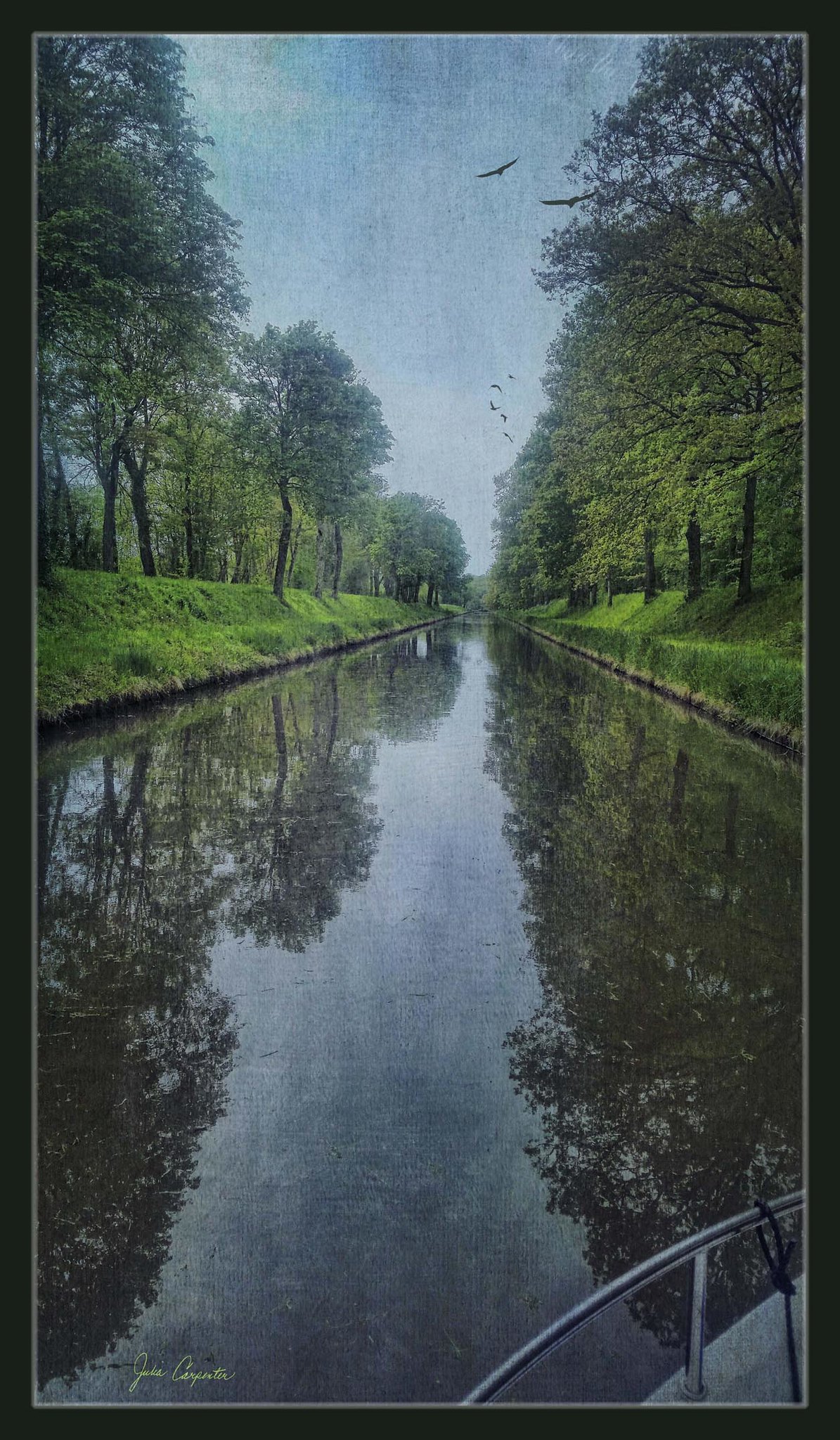
On the Canal du Nivernais

For some time Mr. C and I were taken with the idea of boating in France. That is, just the two of us in some smart little craft gliding down some scenic waterway. “Your first waterways cruise will be an unforgettable experience,” promises the Locaboat brochure. And it was a week-long Locaboat cruise we chose this past May, from tiny Corbigny about midway on the Canal du Nivernais to the town of Joigny on the river Yonne, in Burgundy.

Lauded as lovely and peaceful with unspoiled countryside, the Canal du Nivernais, built between 1783 and 1842, is now plied only by recreational craft. It seemed ideal, especially for neophytes like ourselves. 

 So how did reality compare to rosy expectation? First of all, it was an adventure, but adventures are not stress-free.Take the usual anxieties of travel and add to that trying to master (or at least handle adequately) everything in this totally new milieu. Simply driving the boat is not difficult, but maneuvering, i.e. entering a lock, mooring, takes some skill (and luck). As to the locks, despite the assurance on Locaboat's website that “there's no need to worry about them,” we found each lock to be somewhat of a challenge in one way or another.


On this particular itinerary there are
sixty-two locks, and going downstream as we were (meaning that the water was at lock level on entering, so we were “locking down”), one person must jump to the lock side to secure the boat. There are also several lift bridges which require someone to hop out to open and close them. Plus there's tying up for lunch and in the evening. Everything entails much hauling and pulling on the ropes. So the intervals of idyllic cruising are brief, and those of physical activity are frequent. I even lost weight!

 We were probably fortunate in going early in May, even if the weather was a bit chilly, because we enjoyed solitude along stretches of the canal. Eventually we caught up to another Locaboat going our way with three American couples around our age and often went through the locks with them. The locks (écluses) on the Canal du Nivernais have charming little houses that formerly housed the éclusiers, but now the lock keepers are government employees zipping up to the locks in vans. Each oversees several locks and were generally pleasant and helpful, especially the young women. Obviously they were accustomed to the bumbling efforts of vacationing boat renters, and it surely helped that we were passing through before the summer hordes wore down their patience. 
 

Overall we encountered mostly helpfulness and good will all along our cruise, from the other boaters, from the people who oversaw the moorings, and from the employees of Locaboat. We were also quite pleased with our Pénichette Classique, the smallest of the Locaboat fleet, but quite adequate for two people. In fact, it was fun spending a week on the cozy little boat, falling asleep to the lapping of the water, eating a meal we had cooked on the galley's stove. 
 

We explored the towns where we moored but didn't bicycle off to discover more distant attractions, both because we were often tired from our exertions on board and also because there simply wasn't time. The cruise was not really “at our own pace,” nor, despite our slow speed, was it all that leisurely, due to the aforementioned locks. “What time will you be leaving in the morning?” the lock keeper wanted to know the evening before. Then there were the mandatory mid-day halts when the lock keepers were at lunch. And, of course, there was the time specified for arrival at our final destination. So we had to keep going, even through one miserable day of cold, unceasing rain.
 
At the small city of Auxerre, where the Canal du Nivernais ends, the swelling river Yonne bustles with boats big and small. Thank goodness we were “experienced” by then! Another day on the river, navigating new sorts of locks along with much larger boats, brought us finally to Joigny and the conclusion of our journey by water. We were tired and we were ready for a long shower in a big bathroom. But most of all we were so glad that we had finally had this adventure that we had thought about for so long. 
 
And now that we know more or less what to expect...we are thinking about doing it again! (Although on a different waterway with fewer locks.) And if anyone reading this is pondering a similar adventure afloat, please feel free to get in touch.

Friday, November 22, 2019

Buttoned up

Sometimes you can't resist the temptation of new fabric, even with a sizeable stash waiting to be sewn. And the minute I opened the package from Marcy Tilton to see the heathered violet linen I had ordered, I was glad I didn't. Luscious color, excellent quality, summer-perfect weight for a top. So how was I going to make it up?   

I wanted something simple, easy-to-wear, loose but not oversized. So I turned to Pinterest and searched for linen tops. Well, you know how it is, diving into Pinterest searches. Soon I had a board of tops with interesting detailing: pleats, tucks, creative necklines. My eye kept returning to one with a neckline placket 
 closed by two Chinese knotted ball buttons.

 The neckline and the general look of the top were the only things I copied, preferring to have a set-in rather than cut-on sleeve and a slightly more shaped body with bust darts. I used Butterick 5390, version C, shortening it to hip-length, with the back slightly longer than the front, and making the sleeve just above the elbow. And, of course, re-doing the neckline.
  
But, oh, those buttons! I got out string and tried following along on YouTube videos...without success. It looked so simple but I could never seem to get anything reasonably resembling those ball buttons. Finally I remembered that I actually had a book on Chinese Knotting (by Lydia Chen ISBN 0-8048-3999-0), with the steps clearly showing the process for tying the button. Still, it took me a very frustrating morning until I achieved the elusive knot. (For anyone trying this, the secret is in the careful pulling and tightening of the cord.) 
  
The next step was covering the string with the linen. I stitched a very narrow bias tube and turned it right side out, pulling it over the string as I did so. Because It was bias, I could stretch the fabric to be narrower that the tube I had stitched, making it fit snugly over the string. In retrospect, I wish I had used a smaller cord to make slightly smaller buttons, as I was worried that the weight of the buttons on the lightweight top might make them droop. I really haven't had a chance to wear the top, since I completed it just after our late warm weather ended, but it seemed okay even with the larger buttons when I had it on for Mr. C to snap some pics. 


The placket was stitched to the inside, turned to the outside and top-stitched. The string inside the bias tube of the buttons was cut off close to the knot and the remainder of the tube inserted under the little crosswise pieces and top-stitched down. The same tiny bias tube minus the string was inserted in the other side of the crosswise pieces for the loop to close the buttons. The neckline is finished with bias. I serged the side, shoulder and sleeve seam allowances before stitching the seams. 

Altogether I'm totally pleased with how it turned out, and I can't wait for next summer to have a chance to wear it.

The cropped pants I'm wearing are also linen from Marcy Tilton.