Showing posts with label stenciling. Show all posts

Thursday, September 22, 2022

Second time around

Once the fabric for this t-shirt was a totally different color with totally different designs. And it just wasn't right. Eventually I decided the only solution was to start over. Some yellow swirls refused to be removed, but I think they just add another layer of complexity under the new design.

For my new color, I wanted a pinky peach which I mixed using Deep Orange, Bazooka Pink and Dusty Rose. For the two contrasts I add some Pomegranate and some Nightshade. All of these are Fiber Reactive Procion Dyes from Dharma Trading Company (some colors no longer available), made up into dye concentrates which I apply by mixing with print paste. 

I began by stenciling the small swirls with a stencil I purchased from Michael's. Then without letting that dry, I used a natural sponge to dab a slightly lighter color mixed with a thinner print paste over all the pieces.

The second session was simply stenciling the one-half inch and one-fourth inch squares (cut on my Silhouette Cameo) in the two contrast colors. And that was enough, so, all in all, a fairly simple design to achieve. (Although all that stenciling and dabbing took quite a bit of time.)


The pattern I used is a copy I made long ago of L.L. Bean's Saturday T-shirt, which is a loose, boxy tee, super comfortable for summer. The fabric is a non-clingy cotton jersey from Dharma. It's so much easier to print the individual pieces while they're flat on a table and sew it up afterwards.

Wednesday, September 15, 2021

Rekindling a passion

It's said that you never forget how to ride a bicycle, and I doubt that I would ever forget how to sew no matter how much time went by. Alas, I found that the same was not true of printing with dye on fabric.

I certainly never meant to abandon doing it. From the beginning I found it a delight. With each piece I created, I was eager to learn more, to try out new techniques. And then? Well, other projects, other interests, life... I cleaned the bottles of aging dye concentrates out of the little fridge I had bought just for them, put away the silk screens Mr C had made for me, folded up the table I worked upon, but I always planned to start again, soon.

And finally, later rather than sooner, I have. For this first project, I decided to adapt a design I had used on a couple of scarves to a tank top, so I could concentrate on the process rather than the design. I did a mock-up in Photoshop with the dye colors I planned to use. Then I relied on Color by Design: Paint and Print with Dye by Ann Johnston, which has been my guide for past efforts.

Because some of my dye powders were past their average shelf life, I tested the colors I intended to use; thankfully all were fine.

 The fabric is a sturdy cotton jersey from Dharma. The stencils I already had from the scarf project. The passion flower is an Art Nouveau design by E.A. Seguy from an old Dover Book. I adapted a leaf for an additional stencil. The background design is a motif from Dover Books Chinese Stencil Designs. First I stenciled on the leaves in green and the petals in resist so that they would stay white. Next I stenciled the stamens of the flowers in a dark purple. I also used that color on the stencil of the little sprinkles, some of which I also stenciled with resist.

Next I brushed on the overall color diluted with a thin print paste. Here, in order to make the color pale, I made it too liquid with the addition of urea water which dissolved some of the resist I had put on in the previous step. Finally I silk-screened the Chinese motif randomly over the front and back using a stronger version of the base color. Fortunately the resist that kept the petals white did not completely dissolve as I had feared, but it wasn't as crisp and clear as it should have been. I tried to remedy this by going over the petals with white Lumière paint, but it was difficult to align the stencil perfectly the second time. 

All in all, I'm pleased with the result. These tanks tops are what I wear around the house during our sweltering Texas summers, and I'm glad to have another one to add to my collection. I've already begun working on a design for my next one, even as summer is slowly slipping away. I'm hoping to keep some sort of dyeing project going from now on.  Time will tell...

Monday, September 15, 2014

Japonesque top

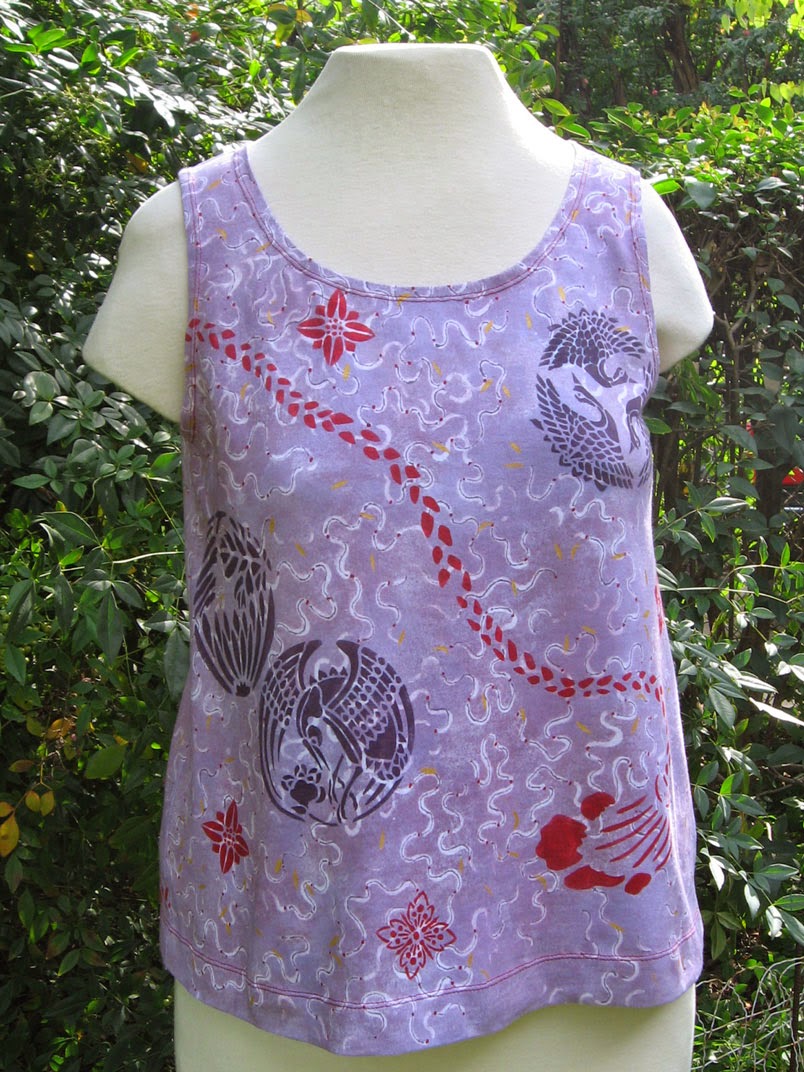
After more than a year hiatus I finally got back to doing some dyeing and surface design.  I tell myself that doing all the things I would like to do is simply a matter of tossing another ball into the air and keeping them all going at a steady clip.  The reality is that the juggling metaphor is somewhat delusional thinking because time is indeed finite.  The time spent doing one thing is inevitably time taken away from another activity.  Especially, in my case, where doing things fast also seems to be an impossibility. 

I did, however, have some help with the stencils I used here.  The circular designs are from Dover Pictura 922 Decorative Vector Ornaments; the cord and tassels are from Japanese Patterns from the Pepin Press.  They would have taken ages to cut by hand with an Exacto knife, but instead I used my new Silhouette Cameo which cut them out in a matter of (very noisy) minutes.  What a fabulous machine!  And stencil cutting is only one of its many uses; I discovered a vast Silhouette Cameo world on You Tube and Pinterest alone.  (I'll also
                                                mention that I bought mine online from B&H: excellent price and service.)


Once I had the stencils ready to go, I printed out the designs on paper and cut them out to decide on placement on the top. Because my Procion MX Fiber Reactive dye powders are well past their supposed effective dates, I did some testing on scrap cloth, both to check their potency and to try out color combinations. (My fabric is cotton jersey from Dharma Trading Company.) Then I stenciled the circular designs and the cord and tassels using dye concentrates mixed with print paste.  That looked too sparse, so I added the three stylized flowers from my collection of old stencils.  After those had dried overnight, I randomly stenciled the squiggles with Jacquard Clear Water Based Resist, using a quilting stencil, allowing that to dry overnight again.  Finally I used a wide soft brush and a foam roller to apply the background color which I wanted to be mottled.  I thought that would be the final step, but after washing out the top, I decided it needed a bit more.  Using the dark purple dye in a squeeze bottle with very fine metal tip, I drew fine lines inside many of the white squiggles with red dots in between.  Over that, sprinkles stenciled in Soft Gold Jacquard Lumière paint. (I frequently wonder how someone else achieved a particular result, so I just ran through the steps here.)


I'm so pleased with the result, and I can't wait to begin on another.  This is one ball that I definitely intend to keep flying through the air!

Tuesday, January 1, 2013

Passion Flower scarves

Mr. C and I are in agreement on making gifts.  We both get a lot more pleasure out of creating than we do shopping, and our hope is that the recipient will appreciate having a one-of-a-kind, made-for-her (or him) item.  So, impassioned as I am at the moment with dyeing and surface design, I set about to dye and print a pair of scarves for two long-time friends (who are states apart so there will probably never be the chance of them appearing together wearing something nearly identical). 
The passion flower was plucked out of one of E.A. Seguy's beautiful Art Nouveau designs from an old Dover Book.  Then, unlike the previous two scarves which were more or less extemporary in composition, I used Photoshop to design the scarf which let me try out elements and ideas.  Over the base color is a motif from Dover Books Chinese Stencil Designs which I hand-cut out of the tablecloth vinyl that I discovered works so well for silkscreening.  The rounded rectangles under the flowers were also cut of the vinyl and silkscreened. The passion flower motif consists of three stencils: one for the petals, one for the stamens and one for the leaves. Lastly are the little "sprinkles" which I found in Photoshop's Shape menu. 

I printed each of the rayon scarves with Procion fiber reactive dye in a different order to see what difference it might make.  To begin, I stenciled the blossoms on both scarves with a resist so that they would remain white.  Then on the scarf with the little black border, I stenciled the leaves, stamens and some of the sprinkles before painting on the background color over which I silkscreened the Chinese stencil design and then the rectangles, followed by some additional sprinkles and the border.  On the second scarf, after stenciling on the petals with resist, I then painted on the background, silkscreened the Chinese stencil motif and then the rectangles.  After that I washed the scarf (because the dye mixed with the print paste builds up), then stenciled on the leaves, stamens and all the sprinkles. The difference was negligible in terms of the final outcome, but it was definitely easier to stencil the complete flower first before the fabric gets pulled and stretched and squeezed during the various processes.
 
I didn't quite achieve my design in terms of colors. The wet color looks so much darker than when it dries, so I need to be a bit bolder when mixing it.  For example, the rectangles are each a different blue, but they are so light on the scarves as opposed to the design, that you really can't tell.  And the Chinese stencil doesn't make very much contrast with the background, especially on the first scarf.  On the second scarf I changed the colors slightly, making the leaves a bluer green, the stamens dark cobalt instead of black, and the sprinkles a combination of cobalt and green.


That's it...much easier said (or written about) than done, that's for sure.  But tremendously interesting to do.  And isn't making something yourself so satisfying, especially when it turns out close to what was in your mind's eye?  And, of course, the way to achieve that is to just...keep doing it, keep trying, keep learning.  So, on this first day of a fresh new year, I wish all of you other crafters out there a joyous year of creating.   For anyone else who yearns to dye or sew or paint or whatever, what are you waiting for?  You will most probably surprise yourself while having a very good time in the process.

Wednesday, December 5, 2012

Scarves - up to my neck in dye


The dyeing and printing go on. I even bought a mini-fridge in which to keep my dye concentrates, as they were usurping the condiments' space in the kitchen refrigerator. I might reach in and pull out a container of #9 scarlet when I actually wanted red wine vinegar. So the purchase of the mini-fridge seals my commitment to continue. In fact, I liked the results of my last two tank tops so much that I thought I would try to duplicate them on rayon scarves. I thought that I had learned enough about what I did that I could duplicate them.  Ah...not quite.

Nevertheless, it was instructive (as well as frequently frustrating), and now I'm ready to move on to some different motifs, colors and techniques. I can hardly wait to see what comes about, since my novice efforts don't seem to render what I envision at the start.  But that does make it interesting.   

Friday, November 16, 2012

A new leaf

Actually a lot of new leaves – blue ginkgo leaves – rescued the original disappointing dyeing outcome which you can see here.  I eyed it without much hope for a few weeks and then decided to act.  Just a yard of fabric, just some time spent and some dye used, nothing except my own satisfaction riding on the result.  The first thing I did was restencil the flowers with a resist, impossible, of course, to align the stencil perfectly with the existing flowers, but ultimately I liked the sort of off-register effect that it created.  Then using a very detailed mosaic stencil I went over the entire piece of fabric with thickened blue dye; you can really only see a hint of that in the background.  Next, I traced some actual ginkgo leaves and cut stencils of them which I used to screen print both in blue and blue-purple.  I followed that with screen printing on the Chinese stencil design that I used on the previous tank top. That color, Black Cherry, made the ginkgo leaves look too pale, so I printed on more in darker shades of the blue and blue-purple.  Voilà, it was finished, and I was more than pleased.  Of course, the process was not as effortless and straightforward as I just described.  Rather it was quite time-consuming and there were a lot of "oh nos!" along the way.  (See those little dots of blue?  They began as some accidental drips, but ended up, in my opinion, enhancing the design after I decided to sprinkle dots all over.)

 
And just a note, for anyone interested in screen printing, I've discovered a great material to use as stencil film, rather than freezer paper which has a finite lifespan.  I was at JoAnn Fabrics when I wondered if tablecloth vinyl would work.  And, yes, it does!  I purchased the thinnest vinyl which was less than $3 for a 60" wide yard, so it's a really cheap material, and the resulting stencil can be washed and re-used ad infinitum.  It's also extremely easy to cut; in fact, it's necessary to go very easy with the Exacto knife. I used it for the ginkgo leaves as well as recut the squiggly shapes in it, so I think it's a real find.

Monday, October 15, 2012

Dye, dye again

Here's the reprise of the concept that went awry in my previous dyeing project.  I'm pleased with this result, and I think changing some of the elements improved my original idea as well.  I certainly came closer to achieving the color scheme I envisioned.


To begin, I stenciled on the same flower I used in the previous try, this time using Jacquard Clear Water Based Resist, first time I had tried it.  A strangely oily and much more liquid product than Presist.  The bottle says that it is tintable with dye so I added a bit of the russet color I had made for an accent.  However, I decided that wasn't the effect I wanted, so I washed it out, leaving behind faint images.  Then I stenciled a different flower design with the resist, this time adding no color. You can just see their embossed-looking shapes in this photo.  Next I silk screened on the same green shapes, cut out of freezer paper, as before,  adding more blue to the green, mixed with print paste.


After that I tried another silk screen technique, using drawing fluid to trace a fairly simple design from Dover's Chinese Stencil Designs.  I simply printed out the design to the size I wanted, taped it to the screen and traced the design with a very fine brush.  Since it was the first time I had tried it, I had no idea of how thickly the drawing fluid needed to be applied to work its magic.  After the drawing fluid dried, I put a few spoonfuls of screen filler on my silk screen and pulled it across with the squeegee.  Once that dried, the drawing fluid is supposed to be washed out with cold water.  Yes, it worked; there was the design, ready to print! 

The final step was the violet background.  Since so much blue had washed out previously, I made my violet much more blue than I wanted and lighter than last try.   I applied it, mixed with print paste, with a small sponge roller.  The next day I thought it was just too blue and used an inexpensive hobby air brush to spray on more violet dye that was a bit less blue, although I really couldn't see much effect from that.  At this point the fabric was fairly wet, and I thought it possible that the resist-stenciled flowers had simply dissolved, as there was barely any visible trace of them.

After each step I let the dye cure overnight.  Finally I was ready to wash my fabric...   The resist-stenciled flowers slowly appeared, white against the violet background.  They did resist the violet, but did not entirely resist wherever the green shapes or the russet design was printed on top of them.  The faint russet-tinged images of the flowers I had originally stenciled and washed out are still there, adding a bit more complexity, which I like. The background lost a lot of blue as it had on my first time, so it came out about the color I wanted, if a bit lighter than I would have liked.  All in all, it was worth trying this again.  I can't wait to try other techniques, other colors.  This is so much fun!

Sunday, October 7, 2012

Dye-sappointment

I saw it in my mind's eye: white flowers with rust centers, green shapes, a rust squiggle running through it all and a violet background.  I stenciled on the flowers with some of my remaining Presist (a water-based resist), using Procion MX Fiber Reactive dye mixed with print paste on the centers.  Then for the green shapes I finally utilized some of the silk screens Mr C kindly made for me a couple of years ago.  So easy!   I cut the shapes out of freezer paper, used a bit of masking tape to adhere the stencils to the silkscreen, then printed them using dye thickened with print paste.  Simple Screenprinting by Annie Stromquist, a Lark Book, is an excellent, user-friendly reference. There were three different shapes which I printed first in a darker green, then mixed with more print paste to give what I hoped would be an echoing color.  On top of that I drew the rust squiggle with dye mixed with print paste in a fine wire-tipped squeeze bottle, which, unfortunately, kept snagging on the knit.  So I went over it with the same dye mixture in a tjanting (used for applying wax for batik)  which worked a bit better but wasn't stellar on close inspection.

I let each step dry for a day before proceeding to the next step.  Finally I was ready for the violet.  My biggest question was if the green shapes – dye mixed with print paste – would resist the violet dye. I brushed on a fairly dark shade of violet mixed with print paste and let it cure for a day.

Then, with bated breath, I washed it all out.  And washed and washed and washed, every bucket full of blue dye.  Oh no!  So instead of the leafy green and blue violet I had envisaged, I had a yellow green clashing unpleasantly with a mauve background.  The rust centers of the flowers disappeared, and somehow the rust squiggle, which is barely visable, turned about the same green as the shapes.


So here is what I've learned.  No 1 is that the particular blue dye I used, which I have had for much longer than recommended, must have lost some of its potency, although I did use it on the previous fish-stenciled top with no problems.  Secondly, the dye mixed with print paste did work as a resist, however the second printing of the shapes which was supposed to be much lighter was almost the same color as the first.  As to the color change and near disappearance of the squiggle and the flower centers, I have no idea.  I'm trying the whole thing again.  I know it's supposed to be about enjoying the process as much as the product, but I can't help but be a bit disappointed when the product falls short of what I envisaged. However, this particular product will not be abandoned and perhaps the process of salvaging it will prove more interesting than my original idea.  So stay tuned!

Tuesday, August 21, 2012

Catch of the day: dyed fish

Here's my second dyeing project in which I tried out uncooked flour resist.  That's what created the background of crackle lines and splotches.  This is from the book Off-The-Shelf Fabric Painting: 30 Simple Recipes for Gourmet Results by Sue Beevers.  Within chapters on Simple Free-Form Techniques, Background Textures, Print Techniques and Resist Techniques, the author demonstrates and explains clearly how to achieve results similar to the beautiful examples she has created.  She uses acrylic and textile paints, but I'm sure most of these techniques would work with thickened dyes – dye concentrate mixed with print paste – which is what I used.


I was intrigued by the uncooked flour resist, a 1:1 mixtures of flour and cold water.  After whisking them to a smooth paste, I spread it fairly thinly on my fabric, then raked through it with a notched plastic trowel.  I didn't achieve the pronounced pattern she shows in her example because it was a bit difficult to rake through the thin paste while keeping the fabric flat and unwrinkled.  The next day the resist had dried to a hard, brittle surface  which I crinkled up here and there to all allow the dye to penetrate.  I was somewhat cautious in my crinkling, unsure of how much dye would go through.
dried resist
dye on resist
first result


What next?  I remembered some very simple fish stencils from Stencilling by Lynne Robinson & Richard Lowther which seemed just the thing.  In their book, the fish are stenciled "swimming" across the front of a piece of furniture, the lighter colored large fish reading as a shadow of the darker large fish, which I don't think is obvious on my top, although I quite like the fish as design elements. I tried out placement by cutting the designs out of construction paper first, then I stenciled the fish and the arcs by dabbing on three related colors with small natural sponges.


 Here they are freshly stenciled, much darker than before they are cured, washed and dried.   I thought I was done, but after what should have been the final washing, the background looked too light, so I did another round of flour resist and dye, using a bit darker colors and being bolder in my crushing up the paste-covered fabric to let more dye through.  Last little touch was to dot on fish eyes of metallic fabric paint. And, of course, sew up the top. 


I'm already planning my next adventure in dyeing and surface design.  If you've ever had the urge to try it, just do it!  Make something you can wear or use, and have fun.  Just keep in mind, it's only an experiment; do the best you can, but don't let perfectionism (my bugaboo) deter you.  You'll be amazed at what you can create.

Tuesday, August 7, 2012

To Dye For

There is something absolutely magical about putting color on a swath of white fabric.  Color we've put on paper from the time we are old enough to hold a crayon, and some of us have put color on walls and perhaps even on furniture and other objects.  But fabric rarely.  If you're around my age, you might have tie-dyed some t-shirts with Rit dye back in college.  And that was the extent of my dyeing experience until around ten years or so ago when my eye chanced upon an ad for Dharma Trading Company in the back of Threads magazine. I sent for a catalog, and the rest, as they say, is history. 

I wish I could say that I've been busily dyeing and printing fabric for those past ten years, learning and honing my skills.  Alas, as much as I love it, as much as it excites me, I've only done it in spurts with too much forgetting time in between.  Two years has gone by since my last venture. (You can see the two shirts I dyed/printed here and here.)  It's actually not all that difficult, but as with any unfamiliar activity that involves both some know-how and preparation, there's always a good bit of the approach-avoidance syndrome involved, at least there is with me.  But I finally got around to it, and here is the first result.

In the sweltering Texas summer, I do wear tank tops around the house, and Dharma's sturdy, non-clingy cotton jersey is perfect. For the pattern I traced a store-bought tank:  two pieces – what could be simpler?  Dharma sells all sorts of clothing blanks, but I'd rather make my own because it's easier to work on a flat piece of fabric than a garment in the round.  I'm planning on making several of these to try out various techniques and processes, and I like that I'm making something I can actually use rather than just experimenting on a piece of fabric.


When I first became interested in dyeing, the most useful/practical book I acquired was Erin Nobel's Dyes and Paints which is an excellent "Hands-On Guide to Coloring Fabric" as it is subtitled. However, the book that really liberated me is Ann Johnston's Color By Design. She sets out so clearly and simply everything you must know and do in order to...just do it! First there are assorted chemicals that you need to have and mix up, not really all that daunting. Then you mix up the dye concentrates, using Procion MX Fiber Reactive dyes, and after that you can create colors by mixing them visually just as you would paint.

The chemicals
The colors


In her book, Johnston points you to single-chemical colors: basic yellows, reds and blues, plus a few others, as your color arsenal, rather than the tempting array of available pre-mixed colors. And while dyes are a bit more complicated than fabric paints, these bond chemically to the fabric, without altering its hand. They are mixed up with warm tap water, are relatively non-toxic, and can be used on all natural fibers. In the Color By Design method, the fabric is soda-soaked prior to dye application and is "cured" by letting it sit for several hours while the chemical bond is formed. All this is probably much more than you want to know, but if you are intrigued or just curious, there is info galore on the Dharma website, about all types of dyes, fabric paints, tools for creating surface design, as well as fabrics, yarn and clothing.   As you can tell, I love Dharma with its amusing hippie vibe.

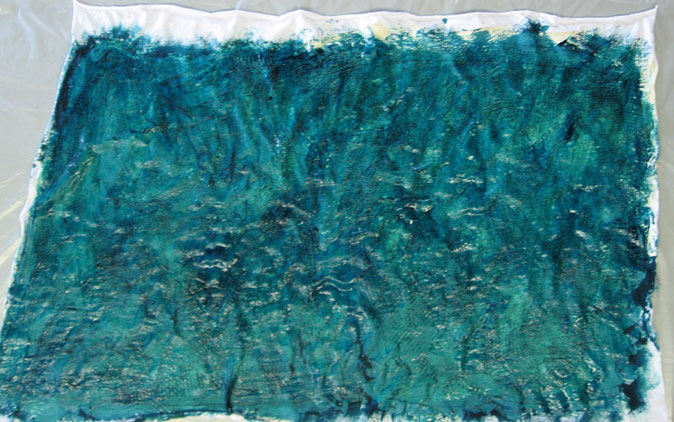
On this project my first step was to brush a color wash on the wet fabric, with the intention of having mauve at the top segue into violet at the bottom.  What actually happened was that I more or less blended them together over the entire piece.  (Before I began I marked my two pattern pieces on the fabric wtih stitching which would be easy to see and durable during the entire process.)  Because my dye powders are older than recommended, I didn't know how much they might wash out.  This photo shows them still wet.

After the base color had dried, I stenciled with print paste (made in the chemical preparation phase) mixed with the dye concentrates.  Only a small amount is needed to color the print paste; I wanted a blue-violet, a red-violet and a plummy shade in between the two, easy to test by just dabbing some on a paper towel.  The stencils are adapted from one of my favorite Dover books: 235 Decorative Designs of the Twenties by Henri Gillet. It's no longer in print but is available on Amazon. Once again I had no idea of how dark the designs would be when it was washed.


After the stenciling had dried, I sponged on dye mixed with more print paste to give lighter shades.  As you can see, it looks very dark when freshly applied and very wet.


Finally, here is the fabric washed and ready to sew.  It has lightened considerably and I've lost a lot of the blue, things I need to take into consideration when I start my next top. Which I'm hoping to do in a just a couple of days!