Monday, February 11, 2019

Worth reading

If you love beautiful garments, you will swoon over the confections in The House of Worth, 1858-1954: The Birth of Haute Couture. Certainly you might have swooned while corseted into one of the boned bodices and metal-hooped cage crinolines which supported the yards and yards of fabric and trim that comprised one of these dresses. But how sumptuous, how splendid, how breath-taking the result! Each garment shown in this richly-illustrated tome will have you marveling at its design and details. 
 
In addition to all this visual delight, the book presents the story of the Englishman Charles Frederick Worth who came to Paris as a young man in 1846 and by 1858 had established what would eventually become the famous House of Worth. It's also a fascinating look into the fashion life of royal and aristocratic ladies as well as those from the artistic and demi-mondaine worlds, beginning at the time of the extravagant Second Empire in France, when the Empress Eugénie became Worth's loyal client.


From the voluminously-skirted gowns of this era to the bustle-backed styles of the later 1800s, Worth's creativity and his love of opulence and ornamentation is magnificently demonstrated. His son, Jean-Philippe, entered the business as a designer, and I do admire some of these later turn-of-the century designs, executed after Charles Frederick had died in 1895.

 Looking at all these frilled, embroidered, bejeweled, lace-adorned silks and velvets, I could not help but muse on the woman that they presented and the woman that wore them, for they surely would shape both outward and inward concepts of the wearer. Such perfection, such utter femininity. But also, such artificiality, such discomfort!

One passage from the book especially stays in my mind. “The empress [Eugénie] was fond of an active lifestyle and liked to dress very simply when she was not engaged in public duties, often in a black skirt caught up over a red underskirt, worn with a loose-fitting shirt... It was wearing a similar outfit that she scaled the Mer de Glace glacier near Mont Blanc.” Can you imagine doing that in skirts!? It made me think of the famous quip about Ginger Rogers and Fred Astaire, that she did everything he did, but backwards and in heels.

 So it is easy to see how women embraced the flapper fashions of the Twenties. About one dress from 1924-27 the description concludes: “Dresses of this kind have no internal structure and rely entirely on the body to support them.” How wonderful that must have felt after all the tortuous shaping the body had previously been subjected to. But I have to admit that for ahh-inspiring beauty, these shapeless dresses, however artistically adorned, can't compete with those incredible clothes from decades before. Even the more lavish New Look styles with which the history of the House of Worth closes in 1954 pale in comparison. 

Yes, I am grateful I live in the age of knits and spandex and denim, and linen that is allowed to wrinkle. But The House of Worth will make you yearn, if only for a moment, to be swathed in a luscious silk, a froth of delicate lace at your bosom, embroidered blossoms entwining with pearls down the front, some ruching perhaps, and tassels and ribbons, the skirt spilling out gracefully about you. Just page through this wonderful book and let your imagination waltz away.


Monday, January 7, 2019

The many benefits of reading

Recently I received a Penguin Random House email that touted the many benefits of reading. They included improving memory by activating the parts of your brain that create new synapses for memory; making you smarter by enhancing vocabulary, improving articulation, and increasing creativity; making you more empathetic by improving understanding of others' beliefs and views; as well as relieving stress and lowering blood pressure.

But this one made me laugh. Improves Sleep: Incorporating a reading routine into your bedtime ritual tells your body it's time to wind down and get some sleep. Because who hasn't snuggled into bed for a good read and only to blearily wake up some time later with the book flopped askew on a body part. And woe If it happens to be a weighty tome!
  
We do have one weighty tome in this year's bookgroup selections: Anna Karenina by Leo Tolstoy. It was my nomination and a novel that I read rapturously back in my younger days, in the 1961 translation by David Magarshack (which I still have in battered paperback form). There are several newer translations, and I intend to read one of those this time. After our encounter with Madame Bovary by Gustave Flaubert in 2017, it seemed appropriate that we should share and discuss the story of one of the other most famous fictional 19th century women. 

 
I doubt that Anna will be all that sleep-inducing, but I have been finding my eyelids drooping over next month's book: Censoring an Iranian Love Story by Shahriar Mandanipour, a very unconventional novel, to say the least. Yet it is this sort of book that I might not ordinarily read that makes our bookgroup so worthwhile. I'm looking forward to learning more about this novel, this author, this culture, and discussing it with a group of articulate and open-minded women. If you are in the Dallas area and like reading interesting and often challenging books, please come join us.

Monday, December 31, 2018

Hellebores

Hellebores
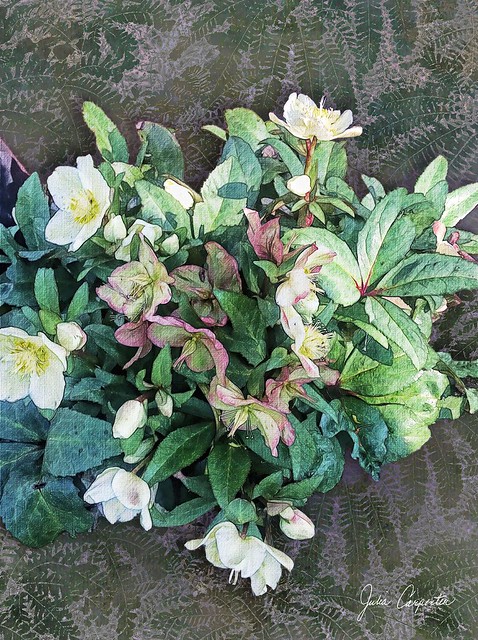
Our city lot is generously shaded by large trees, so I'm always on the lookout for plants that thrive in shade and in our North Texas soil and climate. Hellebores fit the bill, although, alas, they are both slow-growing and a bit pricey. You can't just plant a few and expect them to spread. There are, however, enviable swaths of them at the Dallas Arboretum where I snapped the original photo.
 
One of my Christmas presents (from me to me) was Topaz ReMask, a masking plug-in for Photoshop, so I tried it out on the hellebore image with great success. I played around with just the hellebores on a transparent background, using two other Topaz plug-ins, Adjust and Simplify on separate copies, then Akvis Sketch on another copy. I also enhanced the pinks with a Selective Color adjustment layer.

The background consists of soft, cloudy neutrals on one layer, a deep purple layer over that and two copies of a photo of ferns, one filtered with Topaz Simplify and one with Akvis Sketch. The real magic happens with the blending modes, and there are so many possibilities producing such different effects that I often find it difficult to decide which looks best. (And also find it difficult to stop tweaking.) I finally went with this result which I think makes the ferns look as if stamped or printed on a slightly metallic surface, and they ground the hellebores without distracting from them. There are also a few light touches of gold on top on the background image.

It's been a while since I've done anything “creative” in Photoshop. Because isn't it easy to put aside unessential pursuits for things that “need” to be done. But the satisfaction and pleasure that comes from those pursuits indicate that they are indeed essential, even if the world (or Flickr) isn't breathlessly awaiting another of my oeuvres.

Sunday, December 16, 2018

The Texas road map vest

I should really call this post The obsessional saga of the Texas road map vest. First, here is the result. 


And now I'm sure you're dying to know how and why it I made it.

To begin at the beginning (but skip on down if you'd simply like to know more of the how and not the why)...  Anyway, the beginning was my discovery via Meetup of The Dallas Area Fiber Artists.  I went to the October meeting which was attended by a large and diverse group of women (and a couple of men).  Liza Mackinnon gave a terrific presentation on her intricate paper clothing sculptures, several of which she brought to show. And they were what I had in mind when I started thinking about creating something Texas-themed for the November meeting and holiday party. 

Those free road maps you get at the welcome station to each state – how can you just throw them away? Pinterest has boards full of clever ideas on how to use maps. And I thought it was entirely possible that I could assemble a simple vest, wearable on one occasion, out of my Texas road maps. But as the idea evolved, it turned toward printing the map on fabric, and I was even able to find a pdf of the current Texas road map online, eliminating the need for scanning. 

Friday, August 31, 2018

New fabric, old pattern


The last thing I need is more fabric, which, of course, doesn't keep me from buying more. Anyone who sews understands the difficulty, the near impossibility, of passing up something that is just perfect for a certain pattern, that will “go” with something else, or, in this particular case for me, has colors I like to wear. As you can see, it's sort of a stripe on a very fluid rayon. I was determined not to let it languish in my stash, so began the hunt for the perfect pattern.
  
One thing I have more of than fabric is patterns. Several years ago I organized them and, using a page layout program, made a pattern catalog. So now when I want to look through my own patterns, I don't have to actually go through my pattern boxes. Instead I simply scroll through the files on my computer. And, as I'm sure I've said before, I keep old, even old old patterns because of certain design elements that I can see looking completely contemporary on a new garment.

I remember making this 1970s Butterick pattern in a plaid gauze, much like the illustration on the envelope. I could see my new fabric made up in this because it's a simple silhouette, so undemanding on stripe matching. And I could cut the yoke with the stripes running horizontally and the body with the stripes vertical. Plus I liked its looseness for the fluid fabric.

Alas, I am no longer a size 8, but this was a very easy pattern to enlarge. On the yokes I added 5/8-inch to both top and bottom seams. I also scooped out the front neckline a bit more. Both these changes required drafting new facings which is basically just tracing the new neckline. On the body, I increased the side seams by 5/8” at the top, widening to 1¼ inches at the hem, keeping the same curve as the original pattern pieces. They were also intended to be cut on the bias but worked just as well with the lengthwise grain running up and down.


I wish I could say that thanks to promptly sewing this, I did not add more fabric to my stash, but unfortunately, thinking I would have to do some stripe matching/maneuvering, I bought too much fabric for this simple top. Too much to relegate to the scrap box. So I give myself -1 for buying more fabric, +1 for promptly sewing it, +1 for reusing an old pattern, and -1 for having too much fabric left over. It's a draw. But I did get this very nice top out of it.  

Saturday, June 30, 2018

Almost Very Easy Vogue

Okay, I admit that easy-breezy sewing is not my thing. If I'm going to spend my time making something, I want it to be in my wardrobe for more than one season. That doesn't mean I turn up my nose at Very Easy; I just want it to also be Very Well Made. I want it to keep looking good (especially if it turns out to be a fave that I reach for over and over).

So, on Very Easy Vogue 8534, I was not satisfied with the raw edge neckline that's only finished with top stitching. I know raw edges and the deconstructed look are trendy, but I also know that a neckline needs stabilization or it will stretch out of shape. No problem, I'd just give the neck edge a different, better finish, like a self-binding. But no...that wouldn't really work on the front because the neckline drapes and then goes on to become the two bow ends that need to be fluid. I tried a rolled edge on the serger which I liked for the front but not for the back which should lay smoothly against the neck.
After too much trial and error, I ended up binding the back neck edge while turning under about a 1/8 inch on the front neck edge and bow ends and zig-zagging over them. In retrospect, I see that what I should have done was finish the front and back neck edges separately before sewing the garment together. Which I'll do when I make it again, because I like it well enough to want an autumnal version with the longer sleeves. The bow neckline is flattering and the front darts and center back seam give it some subtle shaping. I also appreciate the cut-on sleeves, which, like raglan sleeves, are a blessing for those of us who normally have to narrow the shoulders for set-in sleeves. 

This is an OOP pattern from 2008, but you can still find it on Etsy or eBay. It's for moderate stretch knits; mine is made from my seemingly endless stash of old cotton interlock. You can read a bit more detail about it on Pattern Review.


Wednesday, April 4, 2018

Illustration Friday - Mushroom

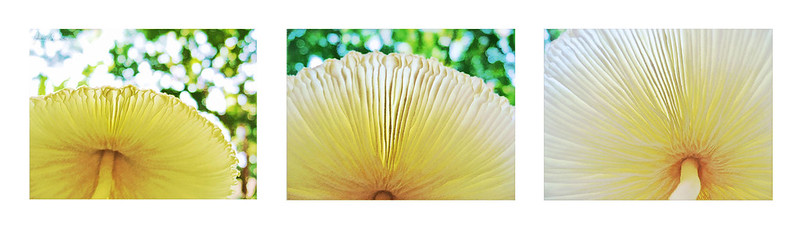
For a number of reasons it's been nearly a year since I've participated in Illustration Friday. I usually do glance at the topic, and for this week's Mushroom, I had just the pics I wanted to work on. Here's what this mushroom looks like from a normal perspective. On the internet I discovered that it is Leucocoprinus birnbaumii, common in potted plants and greenhouses, but this was growing in a neighbor's flower border. I thought it was lovely and snapped several pics of it, including these from underneath which have received the usual intensive Photoshop treatment here. 


Mushroom triptych