Tuesday, May 26, 2015

Learn how to do upholstery – Check

Being a life-long DIY sort of person, my response to reading a how-to article or book is usually "I can do that!"  Or, when the prospective project is beyond one-person proportions, WE can do that.  Fortunately Mr. C is also a DIY sort of person, and our skill sets are more or less complementary.  Although our working styles are much less so.  "Get it done" is his motto, while mine is "do it carefully."  So I have to admit there are frequently some raised voices, to put it mildly, but we manage to carry on.


I'm almost embarrassed to show these Before photos of the chaise and one of the two matching chairs which we bought at an auction thirty plus years ago. We'd had them reupholstered professionally back then, but when they started wearing out, I simply couldn't find the right fabric for the furniture and for the upstairs sitting room they occupy.  As you can see, the situation was getting dire: the old fabric was disintegrating and the springs were sagging and poking every which way. 

Here in Dallas we're lucky to have a lot of great discount fabric stores, and in my quest for that elusive fabric, I amassed quite a collection of samples.  I bought a yard of a couple of fabrics that seemed promising only to reject them when I tried them out at home.  And then I not only found a fabric both Mr. C and I liked, it only cost $70!  Yes, for all of it!

To keep it from looking too utilitarian, I made the trim out of the silky fabric; the embroidery just shows as white accents on the cord.

At this point we had decided to tackle the job ourselves. From the pile of books I borrowed from the library, the two we found most helpful were Singer Upholstery Basics Plus by Steve Cone and Spruce: a step-by-step guide to upholstery and design by Amanda Brown.  I especially like the latter book because of a visual chart which shows the pages for specific design features, such as rolled arms or a tight seat.  And after much searching on the Internet, the videos from DIY Upholstery Supply were the ones we repeatedly referenced.  That was also where we ordered our supplies; you can find everything you need there.

We began at the end of December and had it all essentially finished by the end of March.  Here are the After photos, ta-dah!


Yes, there are some flaws which I know about, but you mostly can't see.  And I found it extremely stressful.  Unlike sewing, where you can usually take apart and re-do if something goes amiss, a lot of the steps here were final.  Plus, there was no practicing, just doing. We had to do it right, or as right as possible, the first time.  But it was also interesting, and it's always empowering to satisfactorily complete a challenging project, especially one that involves learning new skills. If you would like to see some of the specific steps in the transformation of these pieces, read on. 

Wednesday, February 25, 2015

Les Trois Mousequetaires


Indeed, these little leather mice are rugged and intrepid, boldly facing our ferocious felines.  I made them using an old Martha Stewart template. The original directions called for them to be made out of Ultrasuede and filled with catnip, but I took inspiration from an old leather mouse bought years ago and mauled by a succession of cats to the point where it's now merely a scrap.  So I wanted these to be able to stand up to  lots of claws and teeth. It looks like the template is not available on Martha Stewart.com, although I did find a couple of other cute rodent toy patterns.  Catnip Rat Toy and Menswear Mouse Toy.  However, if you'd like the template and directions for this particular mouse, just email me and I'll be glad to send it to you. 

Here are a few tips on making it out of leather; by the time I finished the final mouse (the one on the left), I was getting good at turning them out. The first thing I discovered was that sewing them by machine just didn't work:  too difficult to stitch evenly through the thick leather so close to the edge.  However, after cutting the mouse out, I simply stitched around the edge of the entire piece with a leather needle in my machine, but no thread, just punching holes that I could use in stitching it up by hand. Also, using a pair of jewelry pliers to pull the needle through when hand sewing was helpful.  Next, I "embroidered" the eyes (but no nose) and made whiskers out of some upholstery thread/string.  On the third mouse, I also discovered that attaching the ears before I sewed up the body was much easier, as I could match up the needle-punched holes visually.  Then I sewed up the the top seam and finally the bottom seam, inserting the tail and stuffing firmly with polyester fiberfill.  I figure the ears and the tails are the most vulnerable parts so I took extra care in stitching them on securely.  The cats do seem to love picking them up and slinging them around by the tail.  Here, a couple of our porch kitties who are morphing into house kitties are giving them a try-out.


Tuesday, January 27, 2015

Serging away

An impulse buyer I am not, especially where pricey items are concerned.  Plus, Mr. C and I tend to keep things forever, so buying the right thing always seems imperative.  I consider, debate, agonize and research online before I acquire a possession.  None of which I did when I bought my serger in September.  Since we were going out of town for a week it seemed the ideal time to take my beloved and ageing Pfaff sewing machine in for some preventative maintenance.  Just in time, as I discovered the couple who owned the Pfaff dealership were retiring and the store was closing.  Everything was half price!

There were three sergers, and my eye fell upon a Babylock Eclipse.  I had long wanted a serger, but I kept putting off taking the time to really find out about all their features, and which would be best for me for the money.  Two things stuck in my head: self-threading and Babylock.  So here was a serger that was both.  But was it really half price?  Was it a good buy?  What features did it have?  Would I regret not buying one with more features?  The owners were focused more on their closing business than on making a sale, and the manual for the serger was nowhere to be found. I stared at the little white machine, I fondled it, I talked to a helpful serger-owning customer.  Mr. C, who is inclined to frugality, nevertheless said to buy it if I thought I really needed it.  (Sadly, he didn't say the same thing about a top-of-the-line Pfaff sewing machine which weighed in at several thousand dollars even at half price.)

But, as I said, I am not an impulse buyer, so somewhat regretfully we left the store and drove back to our part of town to go eat.  And the farther away we got, the more I wanted that serger.  Before someone else snatched it up!  So as soon as we sat down at the table, I pulled out my phone and called the store and charged it.  It was mine!  After we returned from our trip, a day before the store closed, I went to pick it up along with my rejuvenated Pfaff.


It stayed in its box for about a week until I sat it and myself down in front of the TV and tried it out while watching the DVD that came with it.  What it does is so final compared to a sewing machine: It cuts off fabric!  It lays down a thicket of thread!  But after serging scrap after scrap it was time to try it out on an actual garment. I had cut out this Marcy Tilton knit top before I bought the serger, and the directions even say to sew the seams first and then finish with serging.  Perfect!  And, yes, that's just how it turned out.  So easy to use!  Such lovely little seams!  The inside of the top is as tidy as can be.  I love it!  I also love this top with its neckband that adjusts by means of little pleats on the outside as decoration, as I've done here, or more subtly on the inside. You can read my Pattern Review here. Then I immediately whipped out the pants I'm wearing here in ponte knit.  They're from an OOP Sandra Betzina pattern, Vogue 1061. You can see them better below in the black version that I made years ago and have worn often.  They're pull-on pants and what's unique about them is the waistband that uses negative ease instead of elastic, so very comfortable.


The purple top is the same Marcy Tilton pattern with the neckband made in a sheer knit burn-out, with the adjusting pleats sewn on the inside.  I also added cuffs of the same knit burn-out.  This is from another project that I'll post here soon.  The burn-out was a perfect match for this very inexpensive, lightweight knit.  Unlike the green top which is a very drape-y, stretchy rayon-spandex knit, I think this one is all cotton and doesn't have a lot of stretch, so I would have been better off cutting it a bit larger, but it's okay.

 I signed up for a basic serging class on Craftsy, and then Craftsy offered the advanced serging class for free, so I've signed up for that also.  I've watched the introductions, but I've yet to proceed any further with either one.  When I do I'm hoping to expand my serging repertoire beyond the basics, but for the moment, the basics are just fine.
 

Wednesday, January 14, 2015

Ready to read

Last year's eleven books have been read and discussed, and now a new slate awaits.

I appreciate being part of a group of readers who are willing to read out of their comfort zone. Occasionally there are some grumblings about the number of "depressing" books we've chosen over the years.  So why do we choose to read them, these stories about desperate lives, dangerous places?  Interestingly, if you do a Google search for "depressing books" you'll find a host of responses, some arguing for their various benefits, others swearing off of them altogether.  One blogger said she was glad she read "tough" books when she was younger, because they improved her in various ways, but now all she wants is to be entertained.

Well, don't we all like to be entertained?  I like mysteries, which usually involve a violent death, not really a pleasant subject when you think about it, yet definitely entertaining if well written.  But what I want out of my precious reading hours more than entertainment is enrichment. I want to fill my mind with knowledge and understanding of other lands, other cultures, other times.  I want to see them, experience them through narrators and characters different from myself, or sometimes much like myself.  And often that world within the book is one where I would not want to be in actuality, but that may be exactly the point.  Why is this world the way it is, and what do I learn from that? 

I came across a somewhat tongue-in-cheek article in the Telegraph in which the author suggested that dark and depressing novels ought to make people glad about their relatively benign lives.  " Try 400 volts of pure Thomas Hardy and count your blessings that you're not Jude The Obscure."  I think that all of us in my bookgroup would agree with that.  After reading about a slum community in contemporary India in Katherine Boo's Behind the Beautiful Forevers, a memoir of life in war-torn Vietnam in The Eaves of Heaven by Andrew X. Pham or the settling of Australia's New South Wales in Kate Grenville's The Secret River, we certainly have a greater appreciation of our own good fortune, as women living here in this time and place.  We also believe that these books are important for opening our eyes to and increasing our empathy for the infinite variety of other lives. 

Do I feel like all the books that we've read have been "worthwhile?"  I must say that there have been some I'd only force my worst enemy to read (except  he or she might like them!), but, once again, the great thing about a book group is that we can discuss things in the books that disturbed us, that we disagreed with, that we disliked.  And someone else's point of view might just give us a different and illuminating perspective on a "difficult" book.

 Of course, who would really like reading if reading were only about books that were "good for you"?  I also found in The Telegraph a list of 100 novels everyone should read, of which I've read about half.  Some, such as My Name Is Red by Orhan Pamuk and Austerlitz by WG Sebald, were bookgroup selections, but many others – Anna Karenina by Leo Tolstoy, The Portrait of a Lady by Henry James, Tess of the D’Urbervilles by Thomas Hardy, Things Fall Apart by Chinua Achebe, The Tale of Genji by Lady Murasaki – I read because I wanted to know what was in those renowned books, and I read them enthralled from first page to last.

Some books do take getting into, adjusting to their unusual rhythm, altering your expectations.  And sometimes a book just plain disappoints. Even when that happens I tend to slog through to the end.  (Maybe there's a correlation between that and eating everything on your plate, something I happily did without being forced to.)   As always, I'm looking forward to reading all of these books, even the ones I didn't vote for.  Discovering a good book that I would never have considered on my own is also one of the pluses of being in a book group.  I invite you to come join us on our reading journeys, in person if you happen to live in the Dallas area, or wherever you are in the world online. 

 Here's a look at our selections for the past three years. 

Friday, December 5, 2014

Scarlett in Austin

Well no, not Scarlett O'Hara herself, who is, after all, a fictional character in that saga of the Old South, Gone With the Wind.  But her moss green dress made from Miss Ellen's velvet curtains is there, as well as some other choice attire. Along with reams of documentation on the sweeping, unforgettable 1939 movie, they're on view at the Harry Ransom Center at the University of Texas in Austin.  As Texas has no connection to either the setting of the story or the making of the movie, it might seem like an odd place for a 75th anniversary exhibition on the movie, but surprisingly the Ransom Center has many important cultural and literary archives unrelated whatsoever to Texas, including that of David O. Selznick, the producer of GWTW.  And since Mr C and I had never been there, it seemed like a good reason to take a little trip to Austin.

I first saw Gone With the Wind when it was re-released in the 1950s; I remember my parents debating whether I should be allowed to see it, as it contained that "damn" uttered by Rhett at the end.  It was also among the first adult novels that I read; I bought my copy, which I still have, at a little bookstore where the proprietor also gave knitting lessons that I took.  Oh, how I admired Scarlett and her indomitable spirit. Or as Ashley puts it in the novel: "your courage and your stubbornness and your fire and your utter ruthlessness."  Perhaps ruthlessness isn't a very complimentary characteristic, nor is Scarlett's self-absorption and lack of empathy, but somehow those failings never cancel out her appeal and attraction. Right now I'm taking an online course in which several people have named Scarlett as a character who has achieved "person-ness," someone who transcends their fictional world, becoming as believable and real as a person we know.  In short, she is fascinating. 

Also fascinating is the exhibition at the Ransom Center which begins with the purchase of the movie rights for David O Selznick's studio by his agent, Kay Brown, who had brought Margaret Mitchell's thousand-page novel to his attention.  Much of the film's story is told in lively teletypes which capture candid "conversations" that would have been lost had they been over the telephone.  After much to-ing and fro-ing about the feasibility of GWTW as a movie, concerns about casting and more, David Selznick is finally persuaded and Kay Brown begins: "HOLD YOUR SEAT   IVE CLOSED FOR FIFTY THOUSAND   MARVELOUS   THRILLED TO DEATH   WAIT TIL DOS HEARS IT" and later in the same messages adds "FLAGG AND I OUT TO GET DRUNK".  You could easily spend several hours reading all the communications, mostly telegrams and letters, to and from Selznick and the many individuals involved in the film, that line the walls of the exhibit.

 One part of the exhibit deals with the search for an actress to play Scarlett which involved a "Southern Talent Search" through college drama departments and Junior Leagues, with Kay Brown writing her usual witty observations: "We saw every "Miss Atlanta" from twenty years back.  We had people come dressed in in the period and you can imagine what they were like."  Or recounting another scouting trip: "It was all very social and very General Lee."  While most of this search was fruitless, photos of several "discoveries" show young women in the prime of their beauty, most of whom went on to only star in their own private lives.  A lot of well-known actresses were also tested for the role, but who can imagine anyone other than the inimitable Vivien Leigh as Scarlett?

There are sections on all aspects of the film: the casting, the sets, the costumes, the actual filming, and finally the premiere in Atlanta itself. It took three long years at a time when movies generally were made in six months.  And throughout it all, the public was engaged, expressing opinions and giving advice on everything from the proper Southern accent to who should be cast in the various roles.  Especially poignant are the numerous letters written, usually by hand,  mostly by ordinary people, asking for a chance to play Scarlett, proclaiming they "are" Scarlett and explaining their connection to the character.  Despite differing levels of sophistication, what struck me was the obvious sincerity with which they were written, and the optimstic belief that these letters would be read and taken into account, certainly a reflection of the times in which they were written.  I doubt that anyone would expect the same today.

This is a must-see exhibition for GWTW fans, of course, but anyone with an interest in the era in which the film was made will also find it worthwhile. So if you're anywhere near Austin, Texas, be sure to go, but hurry, it ends January 4th. You can make an online visit to the exhibition here.

Saturday, November 1, 2014

On with the shows!

I now have two more shows to my (very amateur) acting credit. Little did I imagine at the beginning of last year when I more or less stumbled onto a free acting class for seniors that it would be an ongoing activity in my life.  But, as I recounted in an earlier post, most of us in the class continued, putting on one show on our own and then participating in another set of classes and a show at the library in the fall. This year we were thrilled to have our original teacher, Hassan El-Amin, returning to conduct two more workshops (made possible by the generous support of the Skillman Southwestern Library Friends).


 Hassan is a member of the Dallas Theater Center's Brierley Acting Company, and it was proposed that we coordinate our workshop and show with the DTC's current production. In February that was the delightful Sherlock Holmes: The Final Adventure in which Hassan had the role of the King of Bohemia. The class got off to a bit of a rocky start, with several of us writing our own Sherlock-inspired skits, while Hassan both endeavored to critique them and hone our acting skills. In the end we performed a combination of some of those skits plus scenes from various professionally-written plays about Sherlock Holmes. And just as in our previous efforts, scripts were still being clutched and lines fumbled until the actual performance when everything miraculously came together.  In addition to our usual premier at the library, we also had the exciting opportunity to put on the show one afternoon at Wyly Theater where the Dallas Theater Center was performing their Sherlock Holmes.
For our August-September workshop, we were given the choice of several renowned plays from which to choose our scenes.  They ranged from Hamlet to Arsenic and Old Lace, with the common theme being that all had been made into classic movies. I played Blanche DuBois, sparring with Stanley Kowalski in a early scene from Tennessee Williams' A Streetcar Named Desire.  It is somewhat intimidating to take on roles made famous by the likes of Vivien Leigh and Marlon Brando, but I think my co-star, Gilbert Rodriguez, a newcomer to our group, and I acquitted ourselves fairly well.  A bonus was getting to attend the final dress rehearsal of the Dallas Theater Center's current production of Driving Miss Daisy in which Hassan has the role of Hoke Coleburn, the chauffeur.  We were the only audience that evening so it seemed like a performance given just for us. The play, and Hassan, have been garnering excellent reviews, here in Theater Jones and Culture Map Dallas.

I've also really enjoyed designing all the programs, flyers and posters for our shows.

I wish I'd had this experience earlier in my life, not because I've discovered an unexpected talent and taste for the theater, but because I've found it beneficial in a more personal way.  Hassan has shown us that being an actor is, among other things, learning how to present yourself.  And performing before an audience, even just before others in the class, helps to banish inhibiting self-consciousness. But, as they say, it's never too late to learn.  

Monday, September 15, 2014

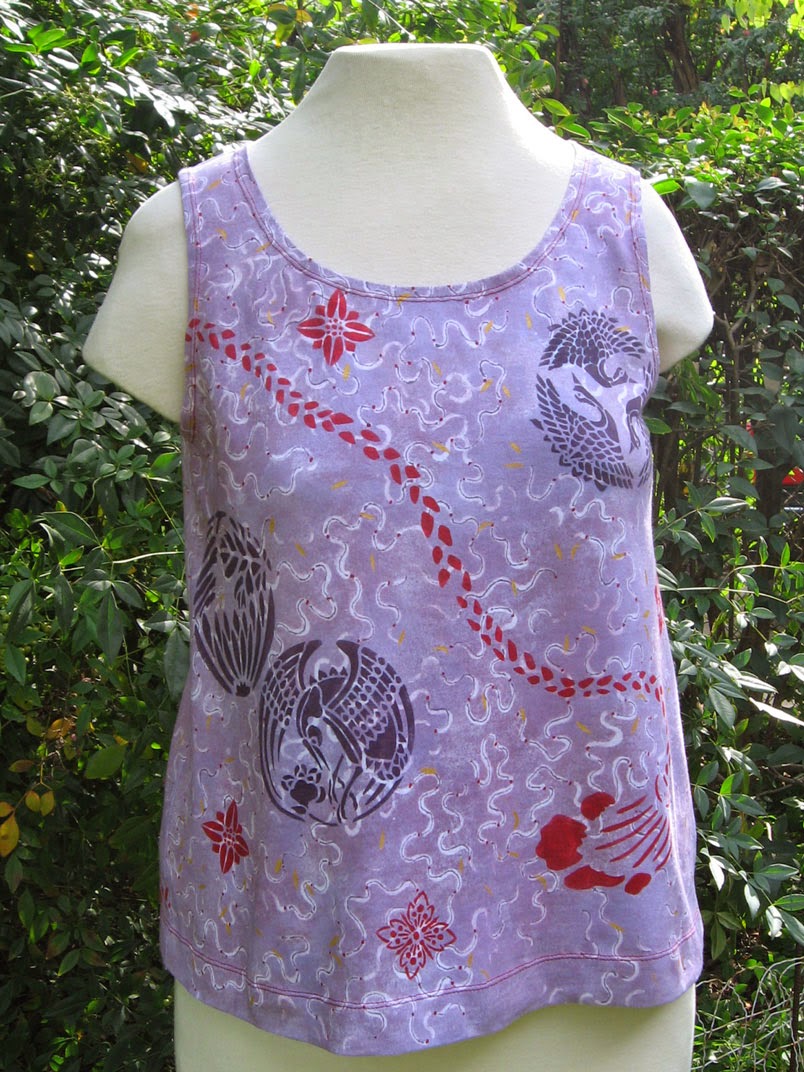
Japonesque top

After more than a year hiatus I finally got back to doing some dyeing and surface design.  I tell myself that doing all the things I would like to do is simply a matter of tossing another ball into the air and keeping them all going at a steady clip.  The reality is that the juggling metaphor is somewhat delusional thinking because time is indeed finite.  The time spent doing one thing is inevitably time taken away from another activity.  Especially, in my case, where doing things fast also seems to be an impossibility. 

I did, however, have some help with the stencils I used here.  The circular designs are from Dover Pictura 922 Decorative Vector Ornaments; the cord and tassels are from Japanese Patterns from the Pepin Press.  They would have taken ages to cut by hand with an Exacto knife, but instead I used my new Silhouette Cameo which cut them out in a matter of (very noisy) minutes.  What a fabulous machine!  And stencil cutting is only one of its many uses; I discovered a vast Silhouette Cameo world on You Tube and Pinterest alone.  (I'll also
                                                mention that I bought mine online from B&H: excellent price and service.)


Once I had the stencils ready to go, I printed out the designs on paper and cut them out to decide on placement on the top. Because my Procion MX Fiber Reactive dye powders are well past their supposed effective dates, I did some testing on scrap cloth, both to check their potency and to try out color combinations. (My fabric is cotton jersey from Dharma Trading Company.) Then I stenciled the circular designs and the cord and tassels using dye concentrates mixed with print paste.  That looked too sparse, so I added the three stylized flowers from my collection of old stencils.  After those had dried overnight, I randomly stenciled the squiggles with Jacquard Clear Water Based Resist, using a quilting stencil, allowing that to dry overnight again.  Finally I used a wide soft brush and a foam roller to apply the background color which I wanted to be mottled.  I thought that would be the final step, but after washing out the top, I decided it needed a bit more.  Using the dark purple dye in a squeeze bottle with very fine metal tip, I drew fine lines inside many of the white squiggles with red dots in between.  Over that, sprinkles stenciled in Soft Gold Jacquard Lumière paint. (I frequently wonder how someone else achieved a particular result, so I just ran through the steps here.)


I'm so pleased with the result, and I can't wait to begin on another.  This is one ball that I definitely intend to keep flying through the air!